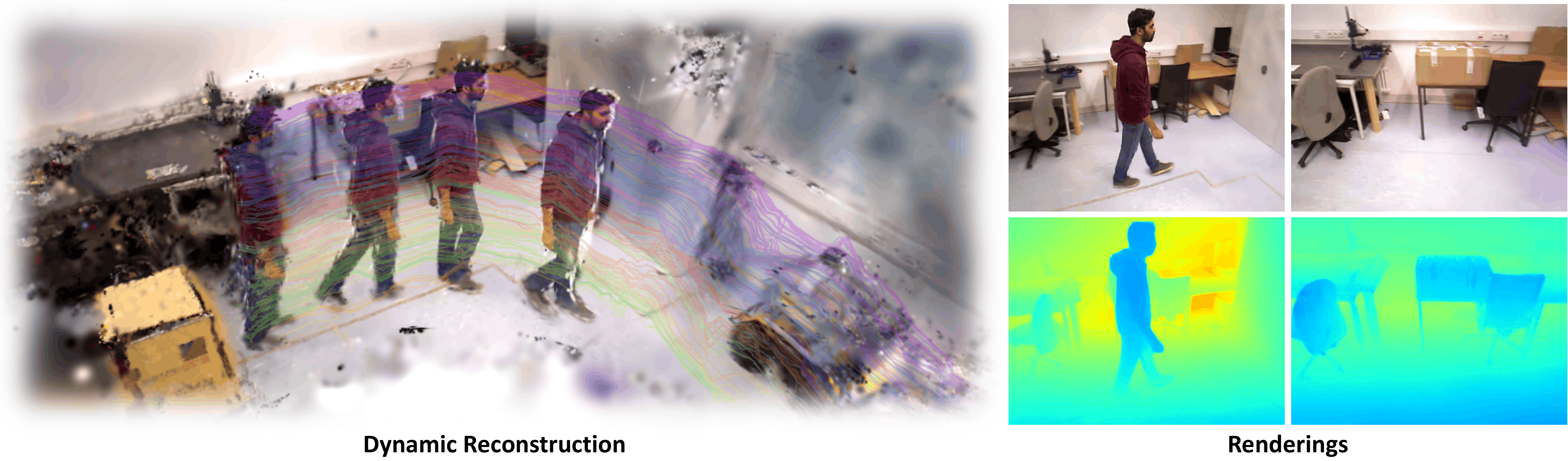
Efficient Dynamic Reconstruction + SLAM: Our Flow4DGS-SLAM solves the complex dynamic mapping and tracking task in a much more efficient pipeline (over 15x speed up).
Abstract
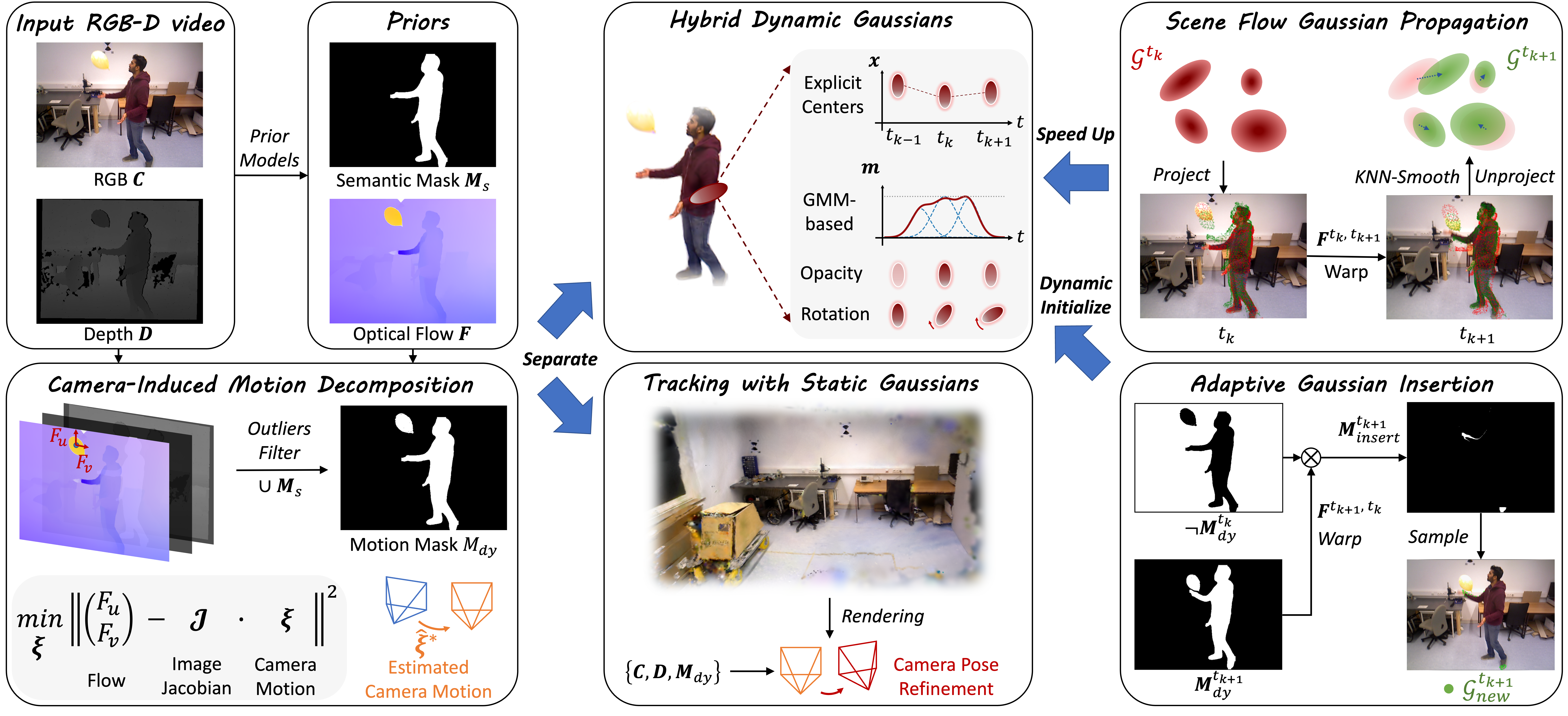
Handling the dynamic environments is a significant research challenge in Visual Simultaneous Localization and Mapping (SLAM). Recent research combines 3D Gaussian Splatting (3DGS) with SLAM to achieve both robust camera pose estimation and photorealistic renderings. However, using SLAM to efficiently reconstruct both static and dynamic regions remains challenging. In this work, we propose an efficient framework for dynamic 3DGS SLAM guided by optical flow. Using the input depth and prior optical flow, we first propose a category-agnostic motion mask generation strategy by fitting a camera ego-motion model to decompose the optical flow. This module separates dynamic and static Gaussians and simultaneously provides flow-guided camera pose initialization. We boost the training speed of dynamic 3DGS by explicitly modeling their temporal centers at keyframes. These centers are propagated using 3D scene flow priors and are dynamically initialized with an adaptive insertion strategy. Alongside this, we model the temporal opacity and rotation using a Gaussian Mixture Model (GMM) to adaptively learn the complex dynamics. The empirical results demonstrate our state-of-the-art performance in tracking, dynamic reconstruction, and training efficiency.
Overall Framework of Flow4DGS-SLAM
Overall framework of Flow4DGS-SLAM. Given input RGB-D video, we first extract the prior semantic mask and optical flow, and feed them into a camera-induced motion decomposition module to filter out category-agnostic motion mask and solve an optical-flow guided camera initialization. The static gaussians help refine the camera pose during tracking, and the dynamic Gaussians are represented in a hybrid form, combined with a scene flow Gaussian propagation module and an adaptive gaussian insertion module to accelerate training.